

Neuromorphic Computing Simplified…
29 May 2026


Neuromorphic Computing…
“Neuromorphic computing, an interdisciplinary field combining neuroscience and computer science, aims to create efficient, bio-inspired systems
Different from von Neumann architectures, neuromorphic systems integrate memory and processing units to enable parallel, event-driven computation
By simulating the behaviour of biological neurons and networks, these systems excel in tasks like pattern recognition, perception, and decision-making
Neuromorphic computing chips, which operate similarly to the human brain, offer significant potential for enhancing the performance and energy efficiency of bio-inspired algorithms”
The Evolution Of Chip Design…
Chip Architecture
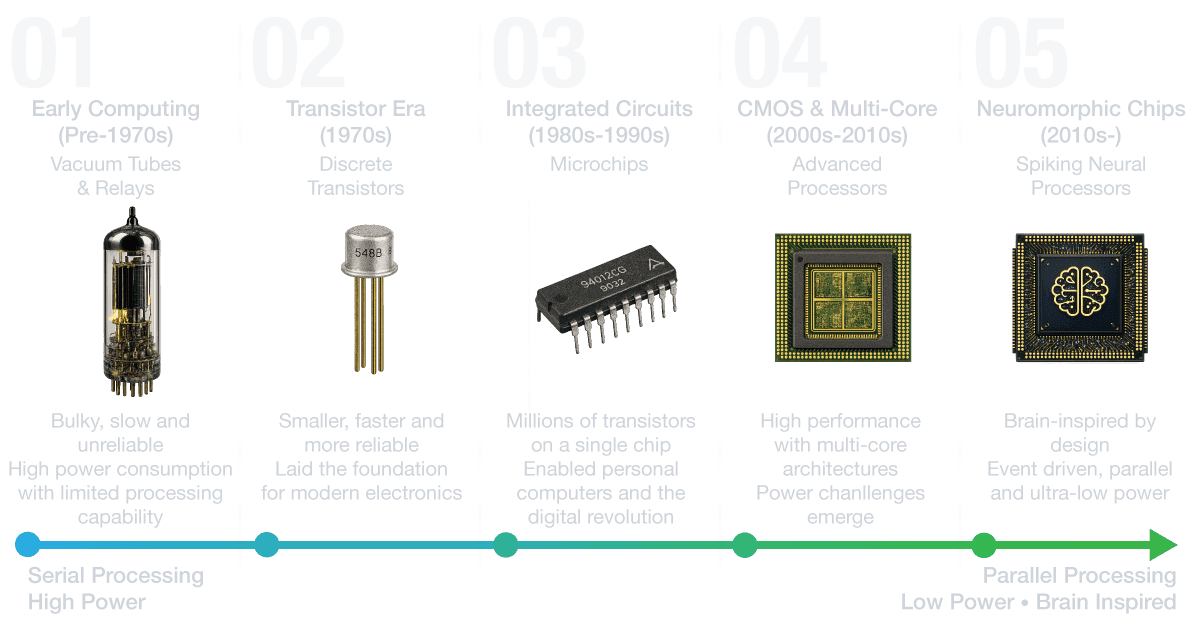
Fundamental Distinctions…
Von Neumann (DNNs) vs Neuromorphic (SNNs)
Feature
Architecture
Information Encoding
Von Neumann Architecture (Deep Neural Networks)
Separate memory and processing (CPU/GPU + memory)
Binary or high-precision values
Neuromorphic Architecture (Spiking Neural Networks)
Integrated memory and processing (compute-in-memory)
Spikes (discrete events over time)
Deep Neural Networks (DNNs) vs Spiking Neural Networks (SNNs)
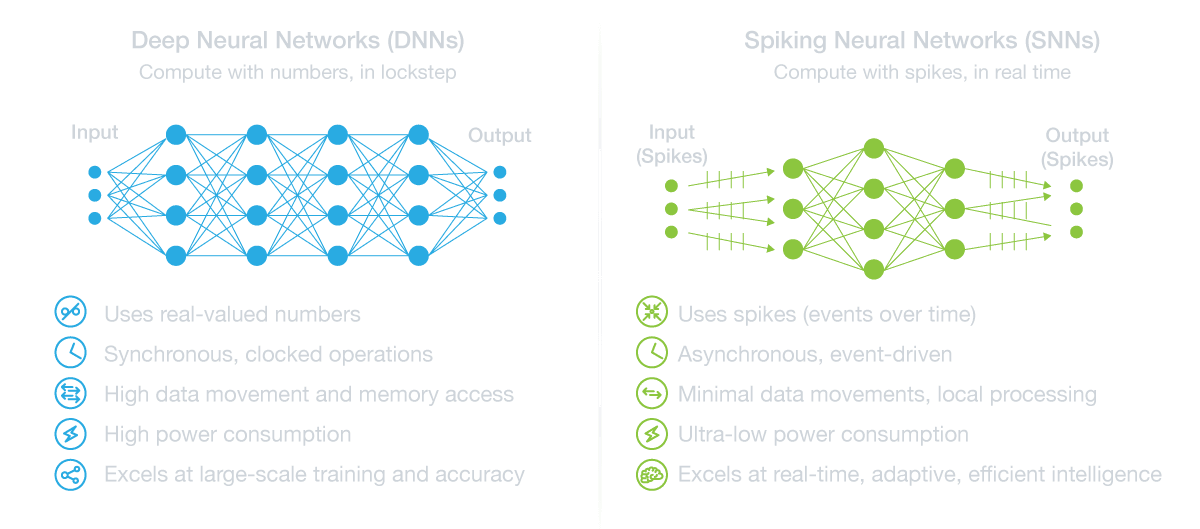
What Changed?

From sequential to parallel: Mimicking how the brain processes information through billions of neurons firing simultaneously

From data movement to data locality: Neuromorphic chips process data where it is stored, eliminating the ‘memory wall’

From constant computation to event-driven: Only compute when something happens, as neurons fire only when needed

From power-hungry to energy-efficient: Orders of magnitude lower power consumption
Why It Matters…
This evolution reflects a fundamental shift - from designing chips that compute like machines, to chips that behave more like the brain
Key Takeaway…
Neuromorphic chips are not just faster and smaller, they are fundamentally different
By simulating the cognitive processes of the brain, these chips unlock new possibilities for AI, robotics, healthcare and beyond
Why Neuromorphic Computing Made QiD Possible…
Interpreting personal identity is a complex, dynamic and highly individual pattern recognition problem
Traditional computing struggles with:
✗ The massive variability of human behaviour and context
✗ Real-time adaptation to new experiences
✗ High energy cost of continuous computation
✗ Protecting sensitive, personal data
Neuromorphic computing overcomes these by enabling:
✓ Real-time learning from sparse, meaningful events
✓ Continuous adaptation, similar to brain function
✓ Ultra-low power, always-on intelligence
✓ On-device processing for privacy and security
Neuromorphic computing made it possible for research scientists at aiQ Cognitive Technologies to semantically interpret the essence of being (‘personal identity’) as only the human mind/brain does - efficiently, adaptively, privately and uniquely
QiD: Neuromorphically Interpreting Personal Identity..
Capturing what makes you, you - beyond labels and identifiers

Captures Real-World Complexity: Learns from sparse spikes over time, capturing the nuanced, temporal and contextual nature of identity

Event-Driven Efficiency: Processes only meaningful events, making QiD highly energy-efficient and scalable in real time

Adaptive & Continually Learning: Continuously learning from new experiences, adapting like the brain without needing massive retraining

Privacy By Design: Processes information locally and efficiently, protecting personal data to ensure privacy by design
Neuromorphic Computing…
“Neuromorphic hardware is an innovative computing architecture that mimics the structure and function of biological nervous systems
Its goal is to achieve efficient, low power information processing by replicating the behaviour of neurons and synapses
Unlike traditional computing architectures, neuromorphic hardware employs spike signals for spatiotemporal coding, incorporating simulated neural activity, event-based computing, non-von Neumann architecture, and memory processing
These systems are designed for a diverse array of applications, spanning from neuroscience research to low-power edge intelligence and data centre acceleration
They have the capability to tackle complex tasks with greater parallelism and lower power consumption
This cutting-edge technology is increasingly finding its way into key areas such as healthcare, robotics, artificial intelligence, and the Internet of Things
In the medical field, neuromorphic hardware is skilfully applied to tactile prosthetics
Accurately simulating biological neural activities brings natural and smooth tactile feedback and neural stimulation to users, which greatly improves the practicality and user experience of the prostheses
In the field of robotics, it helps robots achieve real-time perception and intelligent decision making, enabling them to respond to and complete tasks quickly in complex and changing environments
Additionally, neuromorphic hardware demonstrates considerable potential and value in areas such as image recognition, speech processing, and edge computing”